
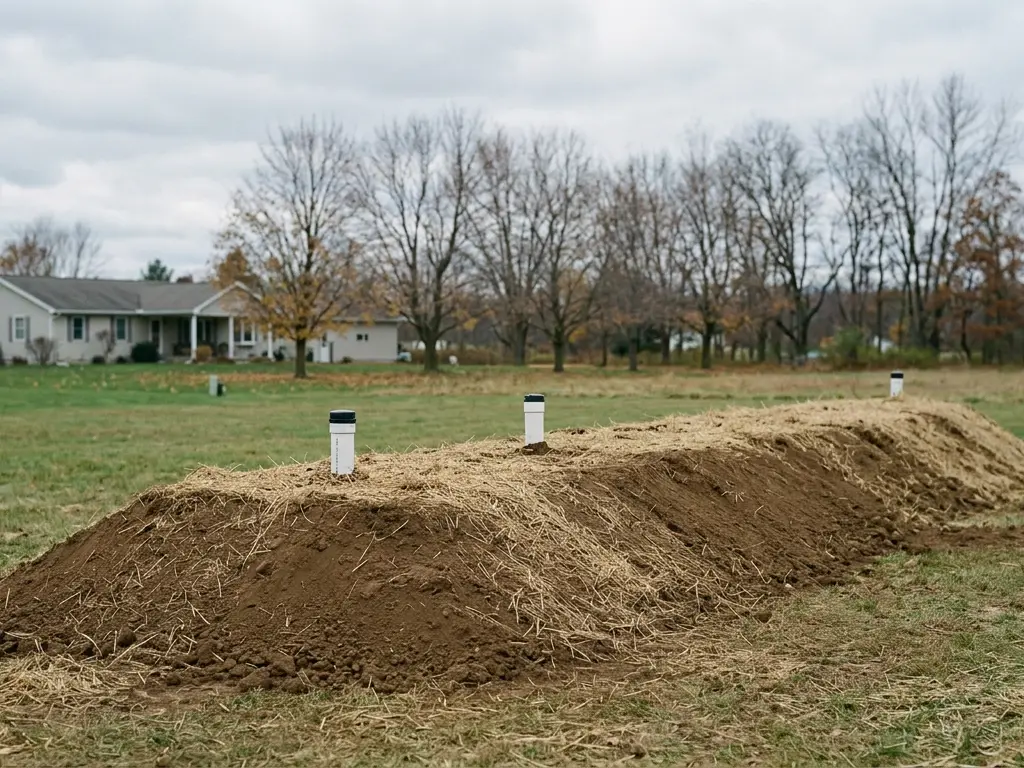
The choice the soil makes for you
Syracuse Septic Pros Guide to Mound vs Conventional Leach Fields in Syracuse
What separates a conventional trench field from a raised system or mound, and why so many lots around Syracuse end up with the second.
- Syracuse and ten towns within 20 miles
- Written price before any digging
- Licensed, insured local contractors
- Built around Onondaga County soils
Syracuse Septic Pros wrote this for homeowners facing a replacement and asking the same question: why does my lot need a mound when the old system was a normal field? The short answer is that the ground has not changed but the standard has, and around Syracuse a lot of ground does not meet it for a conventional field.
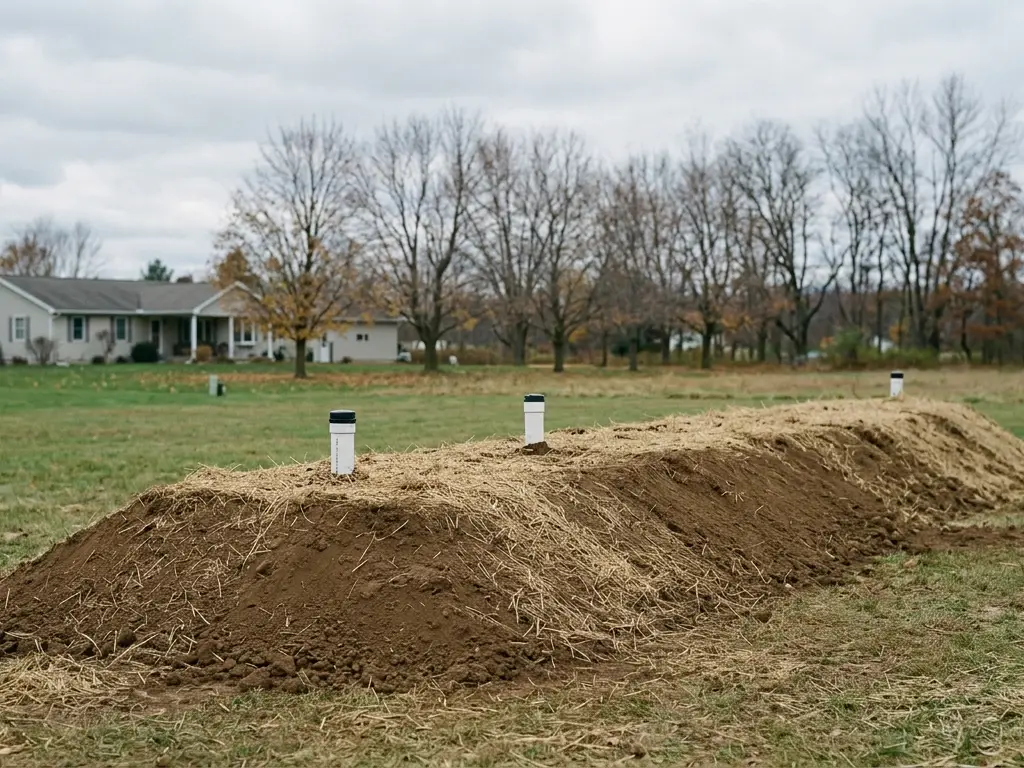
The conventional field
A conventional absorption field is a set of level trenches dug into the natural soil, with perforated pipe on stone or chambers, fed by gravity from the tank through a distribution box. The soil under and around the trenches does the treatment. It is the simplest and cheapest system, and a Syracuse excavator puts a conventional gravity system at $8,000 to $15,000.
New York's standard, Appendix 75-A, sets the conditions. There must be at least four feet of useable soil above rock, unsuitable soil and the seasonal high groundwater, with at least two feet between the bottom of the trench and those layers. Useable soil percolates between one and sixty minutes per inch. Slopes over fifteen percent and land below the ten-year flood level are out.
The raised system
When there is not enough natural soil, the standard allows a raised system: an absorption trench system built in fill with acceptable permeability, placed on top of the natural ground. The trenches work the same way; they just sit in soil that was brought in to give effluent the depth it needs.
Raised systems often need a pump to lift effluent from the tank up into the fill, and they need a NYS licensed design professional.
Not sure what the system needs? Describe what you are seeing and get a straight answer on what it usually takes.
Call (315) 922-5458The mound
A mound goes a step further: a bed of sand fill with pressure distribution, so effluent is dosed evenly across the whole bed rather than trickled into trenches. It is used on the most difficult sites, where the water table is high or the natural soil very tight. It is the most expensive of the three. Backwell prices raised and mound systems at $15,000 to $25,000, with engineered mound replacements at $22,000 to $28,000.
Why Syracuse lots so often need fill
USDA rates soils for conventional septic absorption fields, and around Syracuse the ratings are hard on them. Sampling 25 points in each of the ten towns this site covers, most points came back "very limited", which means at least one soil feature needs special design. The leading reason north of the city is depth to a saturated zone: on the lake-plain silts of Clay, Cicero and Hastings, groundwater rises close to the surface for part of the year. Hastings was rated very limited at all 25 points.
South and west of the city the reason shifts to slow water movement through dense glacial till, which calls for a larger field, and in places to shallow bedrock, which calls for fill.
Onondaga County's fill rules
Because raised systems and mounds depend on fill, Onondaga County has a Fill Certification Form for mound, raised, shallow and supplemental fill systems. Onsite or imported general fill must go through a six-month stabilization period that includes a freeze and thaw. Imported sand or sandy loam can instead be mechanically compacted in lifts no thicker than six inches. The fill is then perc tested against the range in the approved plan, and the form is signed by a NYS licensed professional.
That rule affects the calendar. A raised system using general fill placed in autumn may not be finished until after the next spring.
Why the old system was allowed
Many septic systems around Syracuse were built decades ago, before the current state standard took effect in its present form in 2016, and some were built with little or no soil testing at all. A conventional field installed in ground with a high water table may have worked for years because the household was smaller, the fixtures were fewer, or because nobody looked closely when it started to struggle in spring. When it fails and a replacement is designed properly, the test holes show the water table that was always there.
That is frustrating, but it is also the reason a properly designed replacement tends to outlast the system it replaces.
Not sure what the system needs? Describe what you are seeing and get a straight answer on what it usually takes.
Call (315) 922-5458Other alternatives the standard allows
Raised systems and mounds are not the only options. New York's standard also describes cut-and-fill systems, used where a tight layer of clay or clay loam sits over better soil, shallow absorption trenches for sites with limited depth, and intermittent sand filters. Which one fits is the design professional's call, based on what the test holes show. Around Syracuse, where groundwater and slow soils are the usual limits, raised systems and mounds are simply the ones that come up most often.
Side by side
- Cost: conventional $8,000 to $15,000; raised or mound $15,000 to $25,000
- Soil needed: conventional four feet of useable soil; raised and mound build that depth in fill
- Design: both need a licensed design professional for a new or relocated field
- Moving parts: conventional usually none; raised and mound often a pump, floats and an alarm
- Footprint: a mound stands above the lawn and has to stay free of vehicles and trees
How the decision actually gets made
Not by preference. The design professional digs test holes to find the seasonal high groundwater and any restrictive layer, runs percolation tests, and designs the system the site will support. If the deep hole shows grey mottling two feet down, the design will lift the field; if it shows five feet of good soil, a conventional field may be fine.
Before buying land or budgeting a replacement, get that testing done. The mound septic system page covers what building and living with one involves, and the perc test page what the testing costs.
Questions people ask
What is the difference between a mound and a leach field?
A conventional leach field uses trenches in the natural soil; a mound uses a bed of sand fill above the ground with pressure distribution.
Why do I need a mound septic system?
Usually because there is less than four feet of useable soil above groundwater, rock or tight soil.
What are the signs a lot will need a raised septic system?
Grey mottling or water in a shallow test hole, rock near the surface, or very slow perc results.
How much more does a mound cost than a conventional field near Syracuse?
Roughly $15,000 to $25,000 against $8,000 to $15,000 for a conventional field.
Do mound systems last as long as conventional fields?
Built and maintained properly, both can last many years. Mounds need their pump and fill looked after.
Talk it through before anyone digs
Say what the house is doing, how old the system is and when the tank was last pumped. You will hear what the job usually involves, what it tends to cost, and whether it needs digging at all.
Call (315) 922-5458